Saturn's hexagon is a gigantic six-sided storm swirling at its north pole.
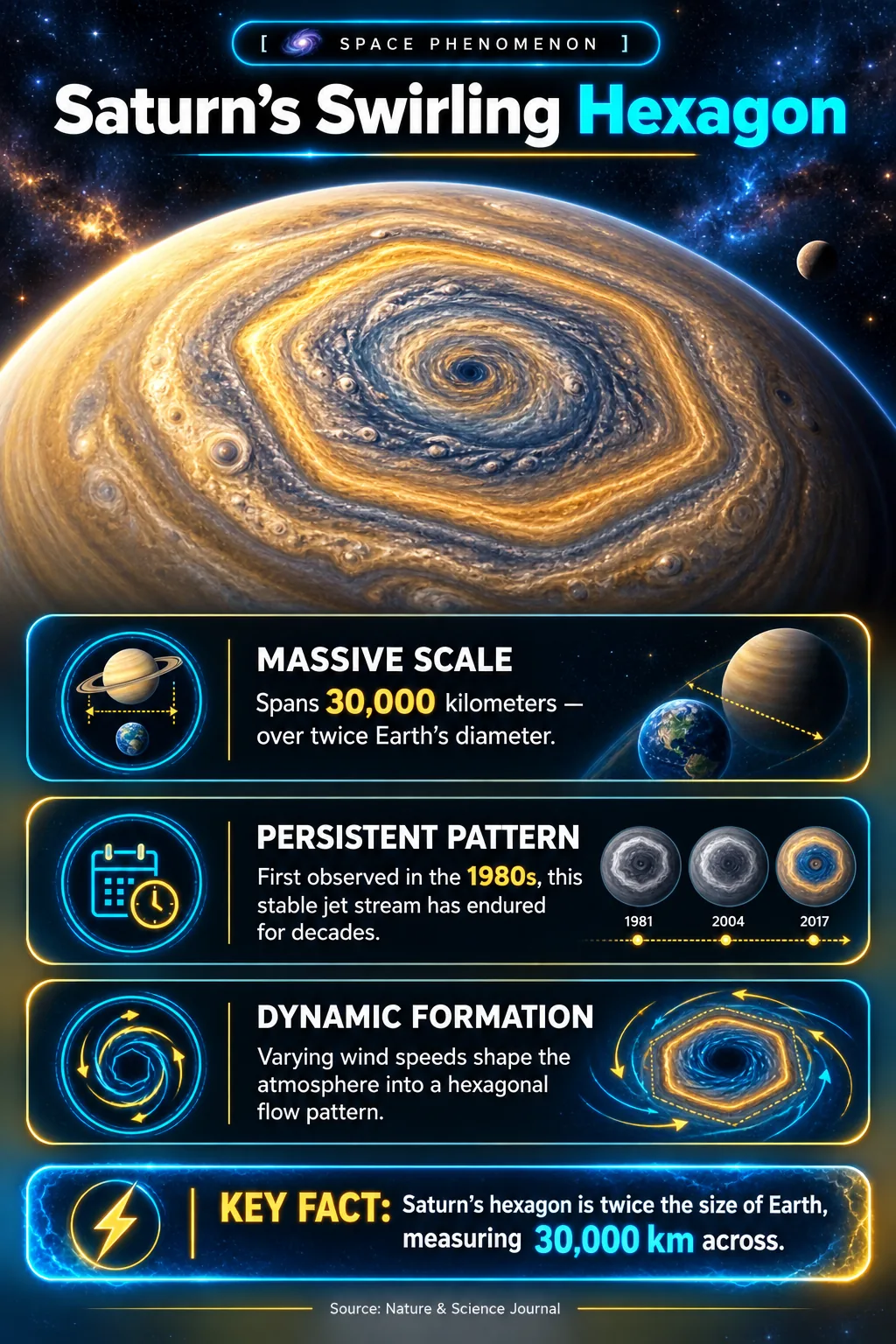
Saturn's hexagon is a gigantic six-sided storm swirling at its north pole.
- MASSIVE SCALE: The hexagon spans 30,000 kilometers, over twice Earth's diameter, showcasing cosmic scale.
- PERSISTENT PATTERN: First observed in the 1980s, this stable jet stream has swirled for decades.
- DYNAMIC FORMATION: Winds moving at different speeds create the hexagonal shape through atmospheric physics.
Saturn's hexagon is one of the most intriguing natural phenomena in our solar system, prominently displaying its massive six-sided shape swirling around the planet's north pole. First spotted by NASA's Voyager probe in the early 1980s, this stunning geometric pattern continues to mesmerize astronomers. This isn't an isolated event but a stable, persistent jet stream that stands as a testament to the dynamic weather patterns of gas giants. Spanning approximately 30,000 kilometers in diameter, the hexagon is more than twice the size of Earth, showcasing the breathtaking scale of cosmic wonders. Scientists believe the hexagon forms due to differences in gas movement across Saturn's layers. When wind speeds within Saturn's atmosphere vary significantly, they create this hexagonal flow pattern, which remains stable over decades. The current scientific consensus is that the hexagon emerges from complex dynamics within the planet's gaseous envelope, although exact mechanisms remain areas of active research. The hexagon's persistence and clarity offer insights into planetary atmospheres, not just on Saturn, but across our solar system. It challenges our understanding and encourages further exploration to uncover the mysteries of Saturn and beyond.


Comments
Post a Comment